Preschool vs Daycare: What's the Difference
& Which One Does Your Child Need?
Navigating early childhood options for your toddler can feel confusing. Discover a clear, research-backed comparison of purpose, curriculum, daily routines, age fit, and decision guidelines for parents in Valasaravakkam, Porur, and Alwarthirunagar.
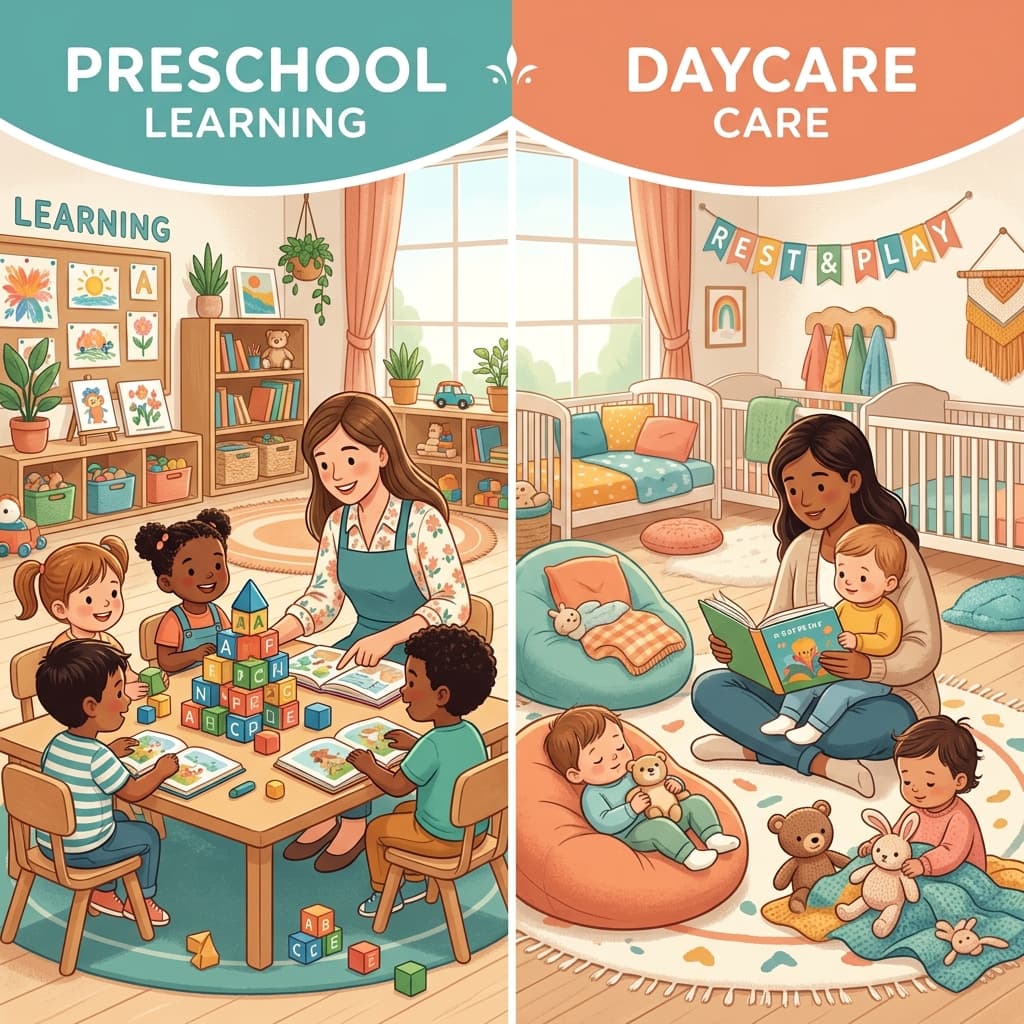

While both preschools and daycares provide safe environments for young children, their fundamental objectives differ:
A structured educational setting (2–5.5 yrs) focused on cognitive growth, language development, social skills, fine motor strength, and primary school readiness.
A full-day care service (6 mos–6+ yrs) providing reliable supervision, meals, naps, and free play to support working parents during full office hours.
The Parent's Dilemma: Understanding Your Toddler's Next Milestone
As your child reaches 1.5 to 3 years of age, conversations at home naturally shift toward early childhood options. Parents in Valasaravakkam, Porur, and Alwarthirunagar often ask: "Should I send my toddler to a preschool or a daycare? Aren't they essentially the same thing?"
Although terms like "playschool," "nursery," and "daycare" are often used interchangeably in casual conversation, they serve distinctly different roles in a child's developmental trajectory. Choosing the right environment depends on your child's age, emotional readiness, developmental goals, and your family's daily schedule.
Let's unpack the 7 fundamental differences between preschool and daycare so you can make an empowered, confident decision for your little one.
7 Key Differences Between Preschool and Daycare
Examine how each option approaches early childhood across curriculum, staff qualifications, hours, and developmental outcomes:
Primary Purpose & Core Objective
Focuses on early childhood education, cognitive development, social-emotional readiness, language skills, fine motor strength, and structured preparation for primary school.
Focuses on child supervision, safety, physical care, feeding, napping, and free play while parents are at work or managing daily responsibilities.
Curriculum & Learning Methodology
Uses a structured, research-backed curriculum (such as play-based learning, EYFS, or Montessori) with specific developmental milestones, thematic modules, and activity circles.
Provides informal, child-led play opportunities, free exploration, story circles, outdoor play, and rest routines without a formal academic curriculum.
Staff Qualifications & Teaching Role
Staffed by certified Early Childhood Education (ECE) teachers trained in child psychology, early literacy, phonics, motor skill development, and positive behavioral guidance.
Staffed by trained caregivers, nannies, and childcare supervisors certified in basic child safety, hygiene, first aid, and toddler caregiving.
Daily Schedule & Operating Timings
Operates on fixed morning sessions (typically 3 to 4 hours per day, e.g., 9:00 AM to 12:30 PM), following an academic calendar with term breaks and holidays.
Operates extended full-day hours (often 8 to 12 hours daily, e.g., 8:00 AM to 7:00 PM), remaining open year-round to match corporate and working parent schedules.
Target Age Groups & Placement
Designed for children aged 2 to 5.5 years, segmented into clear age-appropriate levels: Playgroup (2-3 yrs), Nursery (3-4 yrs), LKG (4-5 yrs), and UKG (5-6 yrs).
Welcomes a broad age spectrum from infants (6 months old) up to after-school children (6-10 years old).
Social Dynamics & Peer Interactions
Children interact within a peer group of identical age, learning turn-taking, cooperative group play, listening during circle time, and collaborative problem-solving.
Children socialize in mixed-age settings, which promotes sibling-like interactions, empathy, and older-younger child bonding.
Assessment & Progress Tracking
Includes regular developmental observations, milestone reports, parent-teacher conferences, and portfolio tracking to prepare children for main school interviews/admissions.
Focuses on daily care logs (eating habits, nap duration, mood updates, diaper/toilet logs) rather than formal academic milestone assessments.
Side-by-Side Comparison Summary Table
Which One Does Your Child Need? A Decision Guide for Parents
Every family's lifestyle and every child's temperament are unique. Use this straightforward framework to evaluate what best aligns with your goals:
Choose Preschool If...
- Your toddler is 2 to 5 years old and ready for structured peer interaction.
- You want to build foundational skills in phonics, math concepts, fine motor strength, and language.
- You want your child to ease smoothly into formal schooling (CBSE, ICSE, Cambridge, State Board).
- You have flexibility at home during afternoon hours (or a family caregiver/grandparent at home).
- You value a curriculum focused on emotional self-regulation, curiosity, and play-based discovery.
Choose Daycare If...
- Both parents work full-time and require reliable, full-day supervision (8-10+ hours).
- Your child is under 2 years old and needs individualized infant/toddler care.
- You need flexible drop-off and pick-up hours aligned with work schedules.
- Your primary need is a safe, cozy environment for meals, naps, and supervised free play while working.
- You require year-round care without school vacation shutdowns.
Choose Preschool + Daycare (Hybrid) If...
- You want the best of both worlds: structured early education in the morning + safe care in the afternoon.
- Your child attends morning Preschool (9 AM - 12:30 PM) and transitions into Daycare care until evening.
- You live in Valasaravakkam, Porur, or Alwarthirunagar and want seamless learning & extended care under one roof.
- You want early literacy and cognitive growth without sacrificing work-life convenience.
Frequently Asked Questions by Parents
Can my 2-year-old go directly to Preschool, or is Daycare mandatory first?
A 2-year-old can comfortably start in a Playgroup program at a preschool like Qurious Lil'Mindz. Daycare is not a prerequisite. In fact, starting in Playgroup helps toddlers develop independent social skills, language, and routine naturally in a child-centered classroom.
Is Preschool necessary if my child already learns at home or in daycare?
While home and daycare provide warmth and social play, a quality preschool provides structured early childhood pedagogy—building pencil grip readiness, spatial thinking, phonemic awareness, group turn-taking, and confidence required for formal primary school.
Does Qurious Lil'Mindz offer both Preschool and Extended Daycare in Valasaravakkam?
Yes! Qurious Lil'Mindz offers an integrated model in Valasaravakkam (serving Porur and Alwarthirunagar). Children enjoy structured morning play-based learning and can transition into our safe, hygienic, and nurturing extended daycare facility for the afternoon.
How do I know if my child is emotionally ready for Preschool?
Key indicators include being able to communicate basic needs (verbally or via gestures), showing curiosity about peers, being capable of brief separations from parents, and following simple instructions. Read our guide '7 Clear Signs Your Toddler Is Ready for Preschool' for more details!