Screens Can Wait:
Why Early Childhood
Needs More Play Than Pixels
A landmark study confirms: children with less screen time in their early years develop stronger memory and perform better academically. Here's what the science says—and what it means for your family.
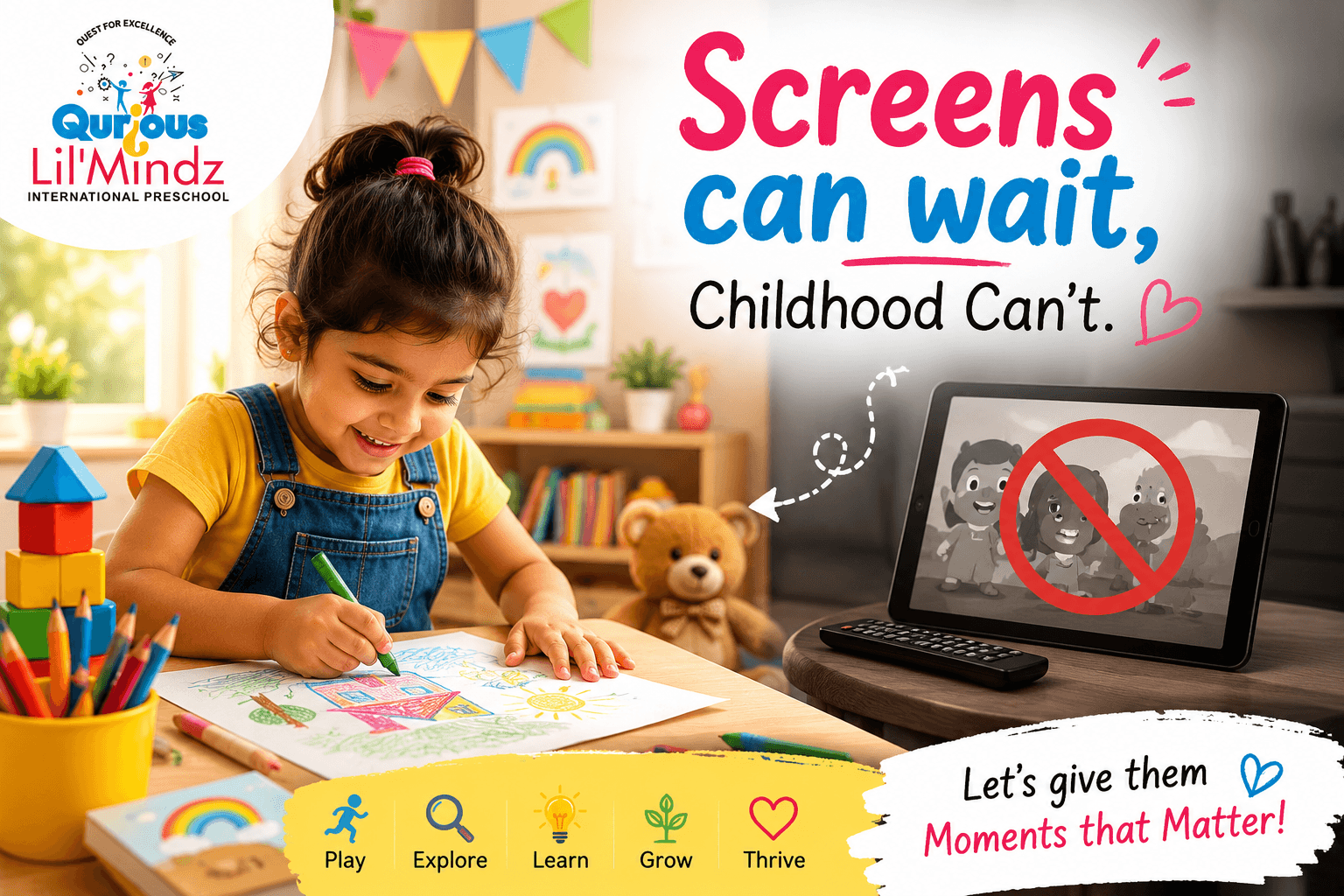

Every parent wants the best for their child. In today's digital world, screens have become a part of everyday life. From cartoons during meals to educational videos and mobile apps, screen time often feels harmless—and sometimes even helpful.
But a recently published study offers an important reminder: when children spend less time on screens during their early years, they tend to develop stronger memory and perform better academically later in life.
Why Are the Early Years So Important?
During the first five years of life, a child's brain develops faster than at any other stage. Children don't learn best by watching a screen. They learn through real experiences that engage all their senses.
Every conversation, every story, every game, and every hands-on experience strengthens the brain in ways that passive screen viewing simply cannot replace.
Children learn by:
What Do Health Experts Recommend?
The World Health Organization (WHO) and leading pediatric experts provide clear guidance on screen time for young children. Unfortunately, many children today exceed these recommendations.
A Balanced Approach — Not a Complete Ban
Technology is part of modern life, and children will eventually learn to use it. The goal isn't to eliminate screens completely. The goal is to ensure that real-life experiences come first.
Reading together, building towers, painting, gardening, solving puzzles, playing outdoors, and simply talking with your child create learning experiences that no app can replicate.
"The future will introduce children to technology soon enough.
The early years should introduce them to wonder, imagination, creativity,
empathy, and the joy of learning through play."
At Qurious Lil'Mindz
At Qurious Lil'Mindz International Preschool, we believe childhood should be filled with curiosity, creativity, movement, and meaningful human connection. Our classrooms are intentionally designed around active, real-world experiences.
We do not use screens as a teaching tool because we believe children learn best through active experiences and meaningful relationships.
Play-Based Learning
Storytelling
Music & Movement
Sensory Exploration
Art & Creativity
Outdoor Experiences
Hands-On Discovery
Social Interaction
Final Thoughts
The future will introduce children to technology soon enough. The early years should introduce them to wonder, imagination, creativity, empathy, communication, and the joy of learning through play.
Because childhood isn't meant to be watched.
It's meant to be lived.
References
- World Journal of Pediatrics (2026). Association between screen time trajectory and academic performance, working memory, and emotional and behavioral problems in school-aged children.
- News Medical. "Early screen time may impact subsequent academic performance and working memory." Published June 22, 2026.