The 60-Second Innovation Takeaway
- The Ancient Genius: Tracing fingers in raw rice was India's original sensory-motor calibration, not an academic handwriting test.
- The June Waiting Trap: Postponing preschool until next June robs your 2-year-old of 240 days (30% of their life) of peak neural plasticity.
- The October Calm: Mid-year Vijayadasami joiners enter already settled, happy classrooms, experiencing 70% less separation anxiety than the June rush.
- The Modern Mandate: True Vijayadasami initiation celebrates asking “Why?”, tactile exploration, and emotional security over rote memorization.
The Rice Plate Paradox: What Ancient Rishis Knew (And Modern Schools Forgot)
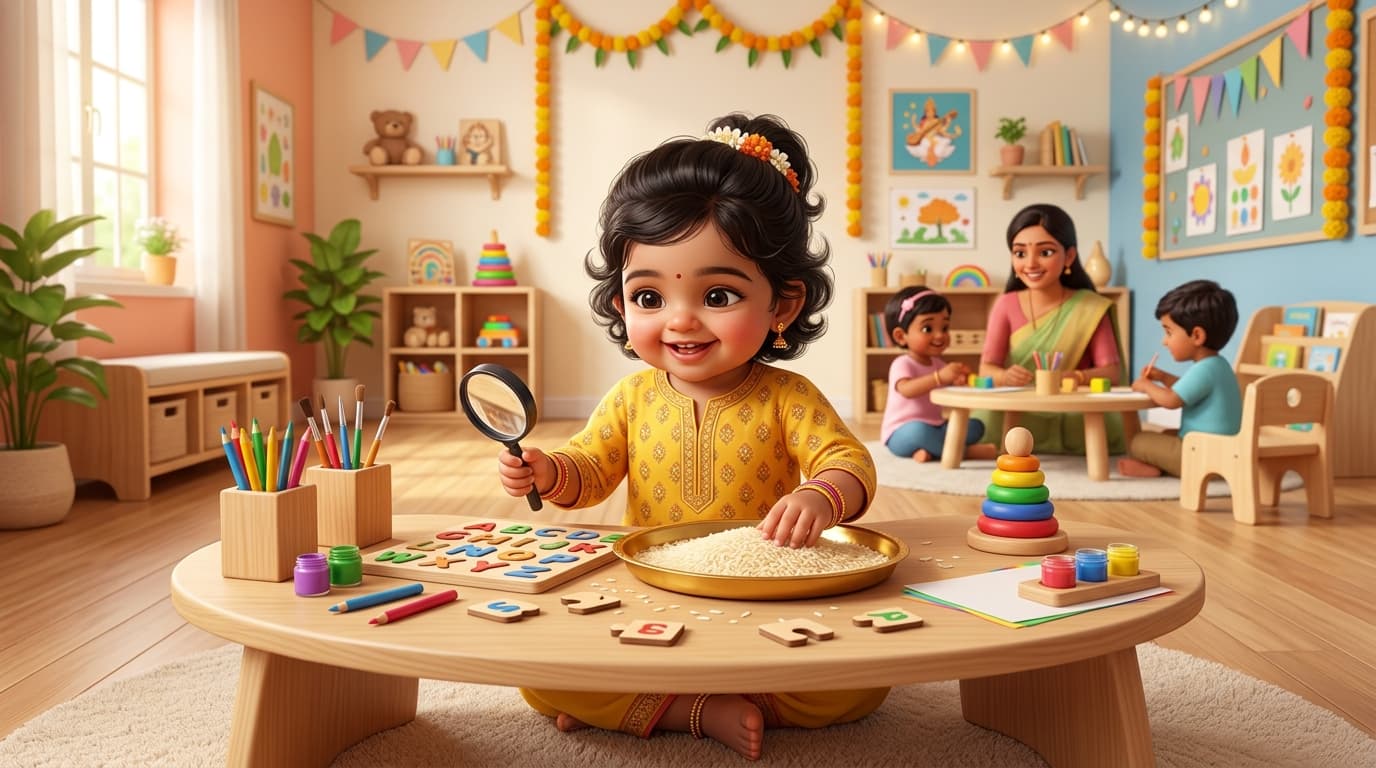
Every year during the auspicious transition of Navratri into Vijayadasami, an enchanting scene unfolds across homes in Tamil Nadu and Kerala. A silver plate is spread with raw paddy or polished rice (Arisi). A child, barely steady on two feet, is guided to trace their first syllable — “Hari Sri Ganapataye Namah” or the cosmic syllable “Om”.
Ask most modern parents why this is done, and the answer is usually: “It is the day Goddess Saraswati blesses our child to begin studying.”
While culturally devout, this explanation misses the astounding neuro-developmental genius engineered into the ritual:
3,000+ Fingertip Receptors
The index finger holds one of the highest densities of mechanoreceptors in the human body. Moving through rough grain stimulates the somatosensory cortex far deeper than tapping a smooth glass iPad screen.
Zero-Friction Pre-Writing
Ancient educators knew toddlers lack the fine motor grip required for hard tools. Tracing in grains allowed kinesthetic muscle-memory without the frustration or bone strain of premature pencil holding.
Ritual of Reverence, Not Testing
It wasn't an assessment. Nobody scored whether the toddler made a straight line. It was an unconditional celebration of human curiosity and initiation into the wonder of language.
“Somewhere in the last 40 years, conventional preschools corrupted Vidyarambham into an academic rat-race: forcing 2-year-olds to hold pencils, drill 1 to 100, and chant phonics. At Qurious Lil'Mindz, Vidyarambham 2.0 reclaims its true origin: the awakening of multisensory joy.”
The “June Waiting Trap”: Why Mid-Year Initiation is a Brain Superpower
When parents in Valasaravakkam, Porur, and Alapakkam visit us in September or October, the most common hesitation we hear is:
This is what neuroscientists and child psychologists call The June Waiting Trap. While administrative calendars operate on a June-to-March cycle, a toddler's neuroplasticity does not pause for bureaucracy.
Waiting from October until June is 8 full months. For a 26-month-old child, that is roughly one-third of their entire existence on earth.
Between ages 2 and 3.5, the brain forms over 1 million neural connections per second. It is the single highest density period in human life.
Toddlers exposed to interactive peer conversations and circle times expand their active expressive vocabulary 4x faster than at home.
What Happens When You Wait 8 Months at Home?
In modern urban Chennai apartments, nuclear family living places immense strain on working parents and grandparents. Inevitably, despite the best intentions:
The Screen Trap Creeps In
To finish chores or attend office calls, toddlers are handed smartphones with YouTube rhymes. This floods their undeveloped sensory circuits with hyper-stimulation, leading to shorter attention spans and delayed speech.
Parallel Play Stagnation
Toddlers miss the critical developmental bridge from solitary play to associative play (sharing spaces, observing peer problem-solving, and building resilience through turn-taking).
Delayed Routine & Toilet Independence
Without the gentle peer-modeling of a preschool environment, diaper transitions and structured meal routines get delayed by months.
Why Vijayadasami Admission has 70% Less Separation Anxiety than June
Here is a counter-intuitive truth that veteran preschool educators know, but few parents realize: Mid-year Vijayadasami admission is the smoothest, most peaceful time for a toddler to enter playschool.
Emotional Contagion
In June, 25 to 30 toddlers enter simultaneously. When one child cries, others naturally mirror the distress. Teachers are pulled across multiple crying children, making the initial 2-3 weeks emotionally exhausting for both parents and child.
Serene Sanctuary & Peer Modeling
By October, the existing classroom is calm, laughing, and humming with joy. The new child walks into an environment of safety. Teachers can offer undivided 1-on-1 lap time, and the newcomer watches happy peers eat snacks and sing songs, settling in days instead of weeks.
The 4 Pillars of “Vidyarambham 2.0”
How do we turn an ancient ceremonial day into a cutting-edge early development sanctuary? At Qurious Lil'Mindz (serving families across Valasaravakkam, Alapakkam, Porur, and Alwarthirunagar), we built our Vijayadasami admissions around four core pillars:
The Vijayadasami Readiness Diagnostic
Wondering if your toddler is ready for mid-year initiation? Check all the behaviors your child exhibits:
Cognitive Hunger & Inquisitiveness
Does your toddler constantly point, ask 'what is this?', repeat sounds, or dismantle toys to see how they work?
Craving for Peer Companionship
When visiting local parks in Valasaravakkam or apartment play areas, do they stare at other children and attempt to join in?
Burgeoning Independence
Are they attempting small 'do it myself' actions like picking their footwear, holding their snack cup, or exploring new rooms?
Expressing Basic Needs
Can they signal basic sensations — thirst, hunger, sleepiness, or bathroom urges — through gestures, single words, or simple babble?
Parental Goal: Reclaiming Screen Time
Are you eager to replace the passive dopamine loop of smartphones & television rhymes with real, hands-on 3D tactile stimulation?
Emerging Explorer! Your little one is on the cusp of social readiness. Our 2-day gentle trial and low student-teacher ratio will provide the gentle nudge needed to blossom.
Conventional Vijayadasami Admissions vs. Vidyarambham 2.0
| Dimension | Conventional Preschools | Vidyarambham 2.0 (Qurious Lil'Mindz) |
|---|---|---|
| Core Objective | ✕Rote drills, letter recitation, and premature pen-and-paper writing | ✓Multisensory stimulation, curiosity awakening, and natural social confidence |
| Initiation Ritual | ✕Forced tracing under adult pressure while elders inspect penmanship | ✓Joyful tactile discovery with rice, kinetic clay, water play, and creative art |
| Separation Strategy | ✕'Tough love' drop-offs with prolonged crying during crowded June cohorts | ✓Gentle phased orientation in an already calm October classroom environment |
| Technology Balance | ✕Often relies on animated TV screens to keep toddlers occupied at school | ✓100% Screen-Free, tactile Montessori-inspired loose parts and experiential play |
| Assessment Style | ✕Rigid report cards ranking toddlers on how fast they memorize tables & ABC | ✓Holistic milestone mapping across physical, social, emotional & speech domains |
How We Welcome Your Child on Vijayadasami Day
Forget cold administrative paperwork and robotic assessments. When you enroll your child during Vijayadasami at Qurious Lil'Mindz, here is what your family experiences:
Organic Turmeric & Rice Welcome
No whiteboards or markers. Children are invited to dip their fingers in golden turmeric-scented rice trays, exploring textures with zero performance pressure.
First Footprint Keepsake Canvas
Every Vijayadasami joiner creates a personalized non-toxic footprint canvas — a treasured family keepsake marking their first independent steps into the world.
Story Circle: 'The Little Owl'
A cozy puppet-led story session celebrating the joy of asking 'Why?' and 'How?'. Children leave with sparklers in their eyes, eager to return tomorrow.
2-Day Gentle Transition Trial
Parents can accompany their child during the first two days to ensure emotional safety, observing firsthand how our caring teachers nurture their unique personality.