Why Early Childhood Development Is Important:
The 5 Essential Domains Every Parent Must Know
Did you know that 90% of brain architecture is constructed before a child enters primary school? Discover why early childhood development matters and how supporting all 5 core domains prepares your toddler for a lifetime of success.
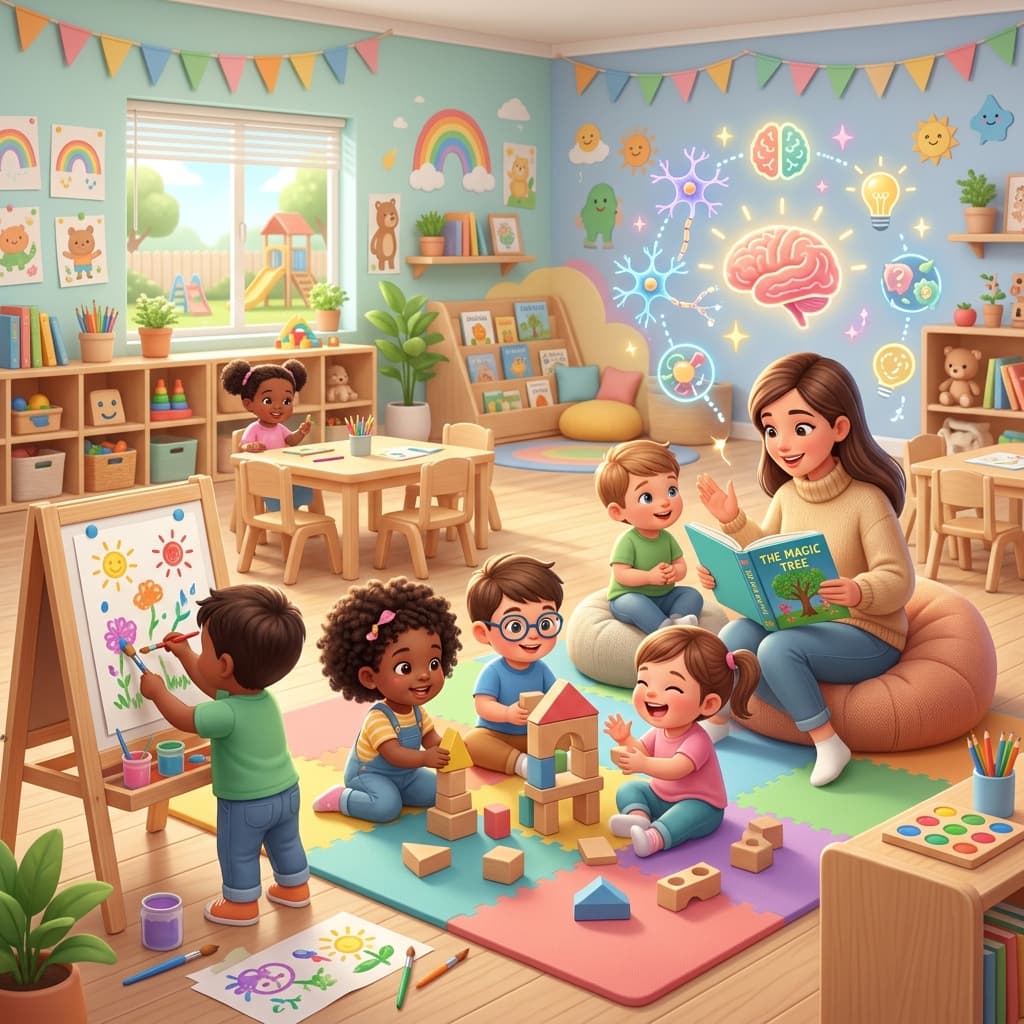
Key Takeaway for Parents
Early childhood development is not just about learning letters and numbers. It is about nurturing the whole child — building emotional resilience, physical coordination, curiosity, communication, and independence during the most plastic period of brain growth.
The First 2,000 Days: Why Early Childhood Development Matters
From birth to age 6, a child's brain develops faster than at any other point in human life. Scientists often refer to this window as the "Golden Age of Brain Architecture." Every smile, puzzle piece solved, story listened to, and gentle comfort offered shapes the wiring of neural circuits.
Many parents ask: "Isn't toddlerhood just for playing and resting?" While play is indeed essential, early childhood development (ECD) forms the structural blueprint for how your child will think, relate to others, manage emotions, and solve problems for the rest of their life.
Over 90% of a child's core brain development occurs before the age of 5, shaping lifelong learning capacity.
In the early years, the brain forms over 1 million new neural connections every single second.
Children with rich early developmental support display significantly higher academic and social confidence later in life.
The 5 Essential Domains of Child Development
True holistic growth occurs when all 5 domains are nurtured equally. Here is a closer look at what each domain entails and why it is vital for your toddler's future.
1. Cognitive Development (Thinking & Problem-Solving)
Building the Brain's Processing Engine
Cognitive development involves how a child thinks, explores, and figures things out. It is the development of knowledge, skills, problem-solving, and dispositions that help children understand the world around them.
2. Social & Emotional Development (Self-Regulation & Empathy)
Nurturing Emotional Security & Relationships
This domain forms the core of child personality and resilience. It includes understanding one's own feelings, developing empathy for others, forming healthy attachments, and regulating emotions during challenging moments.
3. Physical & Motor Development (Gross & Fine Motor Skills)
Empowering Body Strength & Coordination
Physical development covers both gross motor skills (large muscle movements like running, jumping, balancing) and fine motor skills (small muscle movements like grip strength, pencil control, and buttoning).
4. Language & Communication Development (Speaking & Listening)
Unlocking Expressive & Receptive Vocabulary
Language development encompasses listening, comprehending, speaking, phonemic awareness, and early literacy skills. It empowers children to express their thoughts, needs, and ideas clearly.
5. Adaptive & Life Skills Development (Self-Care & Independence)
Fostering Everyday Autonomy & Responsibility
Adaptive skills are the daily practical habits that enable a child to navigate their environment independently — such as eating unassisted, handwashing, packing a schoolbag, and following multi-step instructions.
How Preschool Accelerates All 5 Domains
While home is a child's first and most crucial learning environment, a high-quality preschool creates a structured, social playground where all 5 domains intersect naturally every day.
At Qurious Lil'Mindz (serving families in Valasaravakkam, Porur, and Alwarthirunagar), our curriculum is scientifically crafted around activity-based experiential learning:
Fosters cognitive curiosity, cause-and-effect thinking, and spatial reasoning.
Expands expressive vocabulary, listening comprehension, and early literacy.
Builds bone density, physical balance, cardiovascular strength, and motor confidence.
Teaches sharing, turn-taking, conflict resolution, and empathy.
5 Practical Tips for Parents to Support Development at Home
You don't need expensive toys or elaborate lesson plans to support your child's developmental milestones. Simple, intentional daily moments make a world of difference:
Engage in active 'Serve-and-Return' interactions: Reply promptly to your child's babbling, questions, and facial expressions.
Read together daily: Interactive storybooks build language, emotional understanding, and cognitive imagination.
Prioritise open-ended play: Blocks, playdough, and nature play stimulate all 5 developmental domains simultaneously.
Validate feelings before correcting behavior: Help toddlers label emotions ('I see you are upset') to build self-regulation.
Establish predictable daily routines: Consistent wake-up, meal, play, and sleep schedules reduce stress and build security.
Frequently Asked Questions
Common questions parents ask about early childhood development and preschool readiness.
Why is early childhood development considered the most critical stage of life?
During early childhood (ages 0 to 6), the brain develops at a rate faster than at any other time in life. These early years lay the structural foundation for cognitive ability, emotional stability, health, and social capabilities throughout adulthood.
What are the 5 main areas of child development?
The 5 core domains of child development are: 1) Cognitive, 2) Social-Emotional, 3) Physical & Motor, 4) Language & Communication, and 5) Adaptive/Life Skills. A balanced preschool curriculum addresses all 5 holistically.
How does play support early childhood development?
Play is the natural work of childhood! Through play, children experiment with problem-solving (cognitive), learn to share and negotiate (social), strengthen motor skills (physical), and expand vocabulary (language).
How does Qurious Lil'Mindz support all 5 developmental domains?
At Qurious Lil'Mindz (Valasaravakkam, Porur, Alwarthirunagar), our play-based and sensory-rich curriculum is specially engineered to nurture every domain — from outdoor motor play and phonics activities to emotional regulation guidance and independent life skill routines.
Final Thoughts: Nurturing Potential, One Step at a Time
Every child develops at their own unique pace, but providing a rich, supportive environment during the early years gives them the best possible start in life. When we invest in cognitive, emotional, physical, language, and adaptive skills early, we build confident, curious, and resilient lifelong learners.
Childhood is not a race.
It's about giving your child the strongest foundation to soar.
Research & Scientific References
- Harvard Center on the Developing Child. InBrief: The Science of Early Childhood Development. developingchild.harvard.edu
- UNICEF. Early Childhood Development: The Key to a Better Future. unicef.org/early-childhood-development
- World Health Organization (WHO). Nurturing Care Framework for Early Childhood Development. who.int